Key points#
- Shared decision making means a clinician and patient decide together, joining the evidence with the patient's values and circumstances.
- It matters most when there is more than one reasonable option with real trade-offs.
- It is associated with patients being better informed, more confident, and more satisfied with their care.
- Patients can drive it by asking three questions: what are my options, what are the benefits and harms, and how do those fit my life.
There is an old image of medicine in which the doctor decides and the patient complies. For a narrow set of clear-cut situations, that still has its place. But for a great many decisions, the better model is a conversation between two kinds of expertise: the clinician, who knows the options and the evidence, and the patient, who knows their own life, values, and priorities. That conversation has a name, shared decision making, and it is worth understanding because it leads to care that fits the person receiving it.
What it actually is#
Shared decision making is the practice of making health decisions together rather than having them handed down or, at the other extreme, dumped entirely on the patient without guidance. The clinician brings what the evidence shows: the realistic options, their likely benefits, their possible harms, and how those play out for someone in the patient's situation. The patient brings what only they can: what matters to them, what they are willing to trade off, and the practical realities of their life.
Neither side is sufficient alone. Evidence without the person's values can produce a technically correct decision that is wrong for that individual. Values without the evidence can lead to choices made on incomplete information. Putting them together is the point.
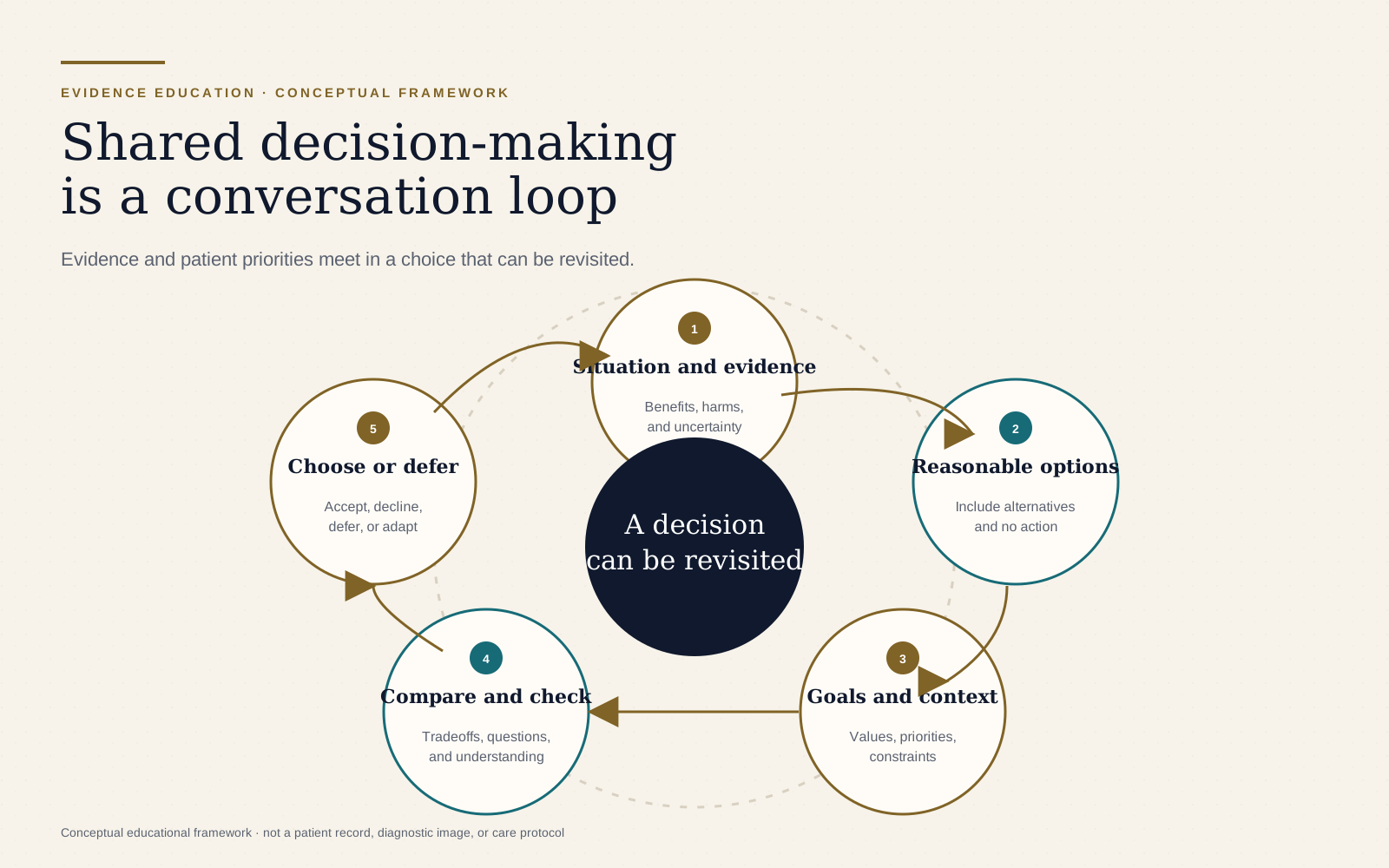
Scroll horizontally to inspect the full figure. A complete text version follows.
Read the figure in text
The loop defines the situation and evidence, identifies reasonable options, elicits goals and context, compares tradeoffs and checks understanding, then chooses to accept, decline, defer, or adapt. The decision can be revisited as circumstances change.
When it matters most#
Not every decision needs a lengthy deliberation. If someone has a clearly best treatment for a serious condition, the conversation can be short. Shared decision making earns its keep when there is more than one reasonable option and the right choice depends on the person.
These situations are common: whether to start a medication whose benefit is modest and whose burden is real, whether to undergo a screening test that carries both potential benefit and potential downside, or how to choose between treatments that trade one kind of benefit for another. In each, there is no single correct answer that applies to everyone. The correct answer is the one that fits this person, and finding it requires their voice.
Why it leads to better care#
The case for shared decision making is not just ethical, though it is that. It is associated with practical benefits. People who take part in their decisions tend to understand them better, feel more confident about the path chosen, and report greater satisfaction with their care. A decision a person helped make is one they understand and can live with, rather than one imposed and half-understood.
There is also a less obvious benefit. When values are surfaced early, care is less likely to drift toward something the patient never really wanted. The conversation acts as a course-correction, keeping treatment aligned with the person it is meant to serve.
How to do it well, from both sides#
Shared decision making is a skill, and both sides can build it.
For clinicians, it means laying out the real options plainly, being honest about uncertainty, presenting benefits and harms in understandable terms, including absolute numbers rather than only relative ones, and then genuinely asking what matters to the person. Approaches such as structured conversation models exist precisely to make this reliable rather than accidental.
For patients, a simple set of questions does most of the work:
- What are my options?
- What are the benefits and the harms of each, and how likely are they?
- How do these fit my life and what I care about?
Asking these is not being difficult. Most clinicians welcome it, because it makes their job easier and the decision better. If a recommendation arrives without options, it is entirely reasonable to ask whether there are any.
At your next real choice#
The next time you face a real choice in your care, treat it as a conversation rather than a verdict to receive or a decision to shoulder alone. Expect your clinician to explain the options and the trade-offs, and offer what only you can: what matters to you and what fits your life. Decisions made this way are better understood, better suited to the person, and easier to live with. Good medicine, for most of the choices that matter, is something done with you rather than to you.
Sources and further reading
Questions and answers
What is shared decision making?
It is an approach where a clinician and a patient make health decisions together, combining the clinician's knowledge of the options and evidence with the patient's values, preferences, and circumstances. It is most useful when there is more than one reasonable choice.
When does shared decision making matter most?
When the options have genuine trade-offs and the right answer depends on what a person values, for example whether to start a particular medication, undergo certain screening, or choose between treatments with different benefits and burdens.
Does it lead to better outcomes?
It is associated with patients being more informed, more confident in their decisions, and more satisfied with their care. People who take part in their decisions tend to understand them better and feel more settled about the path they choose.
How can I take part more actively?
Ask what the options are, what the benefits and downsides of each are, and how likely they are. Say what matters to you. A useful set of questions is simply what are my options, what are the benefits and harms, and how do those fit my life.