Key points#
- The main study types are case reports and series, case-control, cohort, randomized controlled trials, and systematic reviews or meta-analyses.
- Each design suits different questions; the right one depends on what is being asked.
- For questions of cause, randomized trials are usually the strongest single design, and good systematic reviews of trials are stronger still.
- Observational designs are essential where trials are impractical or unethical, even though they are weaker at proving cause.
When you read that "a study found" something, the natural next question is rarely asked but always useful: what kind of study? The design of a study shapes how much it can tell us, and a quick mental field guide to the common types makes you a far sharper reader. None of this requires technical training, just a sense of what each design is built to do.
The common designs, from simplest to strongest#
Think of these as tools, each suited to a different job.
Case reports and case series describe one patient or a handful. They are the anecdotes of medicine, valuable for spotting something new, raising a question, or flagging a rare event. They cannot tell you how common something is or whether one thing caused another, but they often start the conversation.
Case-control studies start with an outcome and look backward. Researchers take people who have a condition and people who do not, then compare their histories to see what differed. These are efficient for rare conditions, but because they look back, they are prone to certain biases and to confounding.
Cohort studies follow groups forward over time. Researchers identify people, note their characteristics or circumstances, and watch what happens. Cohort studies are powerful for describing how risks play out and for studying long-term outcomes, but they remain observational, so confounding is still a concern.
Randomized controlled trials assign people to groups by chance, then compare outcomes. That random assignment is the key move, because it tends to balance both known and unknown factors between the groups. For the question of whether a treatment causes an effect, this is usually the strongest single design.
Systematic reviews and meta-analyses sit on top. Rather than one study, they gather, appraise, and combine many studies on a question using explicit, repeatable methods. A meta-analysis statistically pools the results. A well-conducted systematic review of randomized trials is often considered the most reliable summary of what the evidence shows.
Why a hierarchy exists, and how to use it#
You will sometimes see these arranged in a pyramid, with case reports near the bottom and systematic reviews of trials near the top. The hierarchy is a useful shorthand for one specific question: how confident can we be that something causes an effect? Higher designs control better for the confounding and chance that can fool us.
But the hierarchy is a guide, not a rulebook, and it pays to use it thoughtfully. A small, poorly run trial can be weaker than a large, careful cohort study. A systematic review is only as good as the studies it pools; combining flawed studies does not launder away their flaws. And the highest design is not always the right one for the question. You cannot, and should not, randomize people to a harmful factor to study its effects, so observational designs carry the load there.
Matching the design to the question#
The most useful habit is to ask what the study was trying to find out, and whether its design fits.
- To test whether a treatment works, a randomized trial, ideally summarized in a systematic review, is the natural fit.
- To study the long-term course of a condition, or a risk that unfolds over years, a cohort study is well suited.
- To investigate a rare outcome efficiently, a case-control study earns its place.
- To flag something genuinely new, a case report can be exactly right, as a first signal rather than a conclusion.
Reading this way turns "a study found" into a more useful thought: a study of this type found this, which means I should weigh it like so.
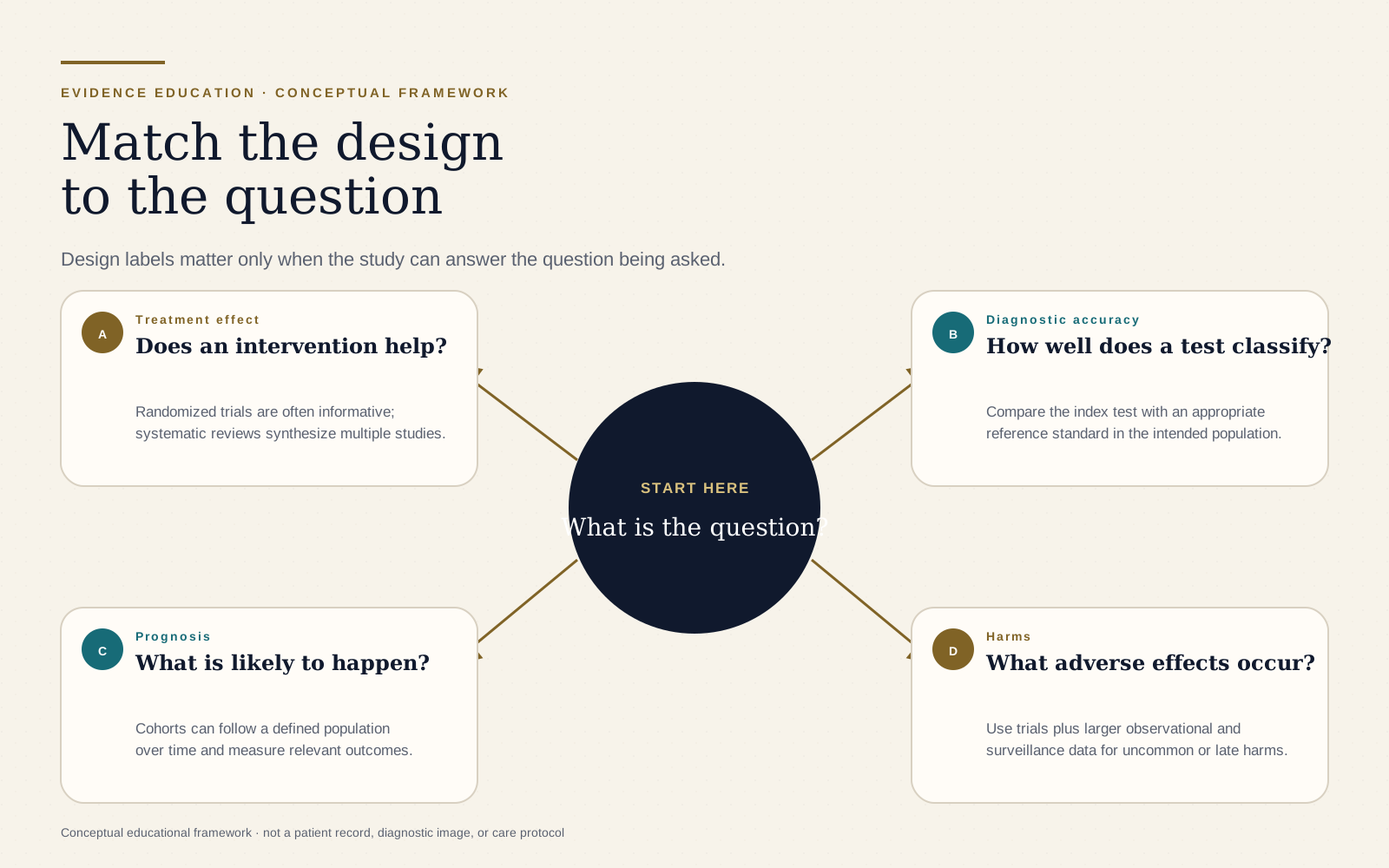
Scroll horizontally to inspect the full figure. A complete text version follows.
Read the figure in text
Treatment questions often use randomized trials and systematic reviews. Diagnostic questions compare an index test with a reference standard in the intended population. Prognosis questions often use cohorts. Harm questions may require trials plus observational and surveillance data for uncommon or late events.
Your quick field guide#
You do not need to memorize a pyramid to benefit from this. Just get into the habit of asking what kind of study sits behind a claim, and what that design is good and bad at. A randomized trial testing a treatment deserves more confidence than a single case report; a sweeping causal claim built on one observational study deserves caution. Knowing the design will not give you certainty, but it will tell you, quickly and reliably, how much weight a finding can reasonably bear.
Sources and further reading
Questions and answers
What are the main types of medical studies?
The common ones are case reports and case series, case-control studies, cohort studies, randomized controlled trials, and systematic reviews or meta-analyses that combine many studies. Each suits different questions and carries different weight.
Which study design is the strongest?
For testing whether a treatment causes an effect, randomized controlled trials are usually the strongest single design, and well-conducted systematic reviews of many trials are stronger still. But the best design depends on the question being asked.
What is a systematic review?
It is a structured summary that gathers, appraises, and combines the available studies on a question using explicit methods. A meta-analysis goes a step further and statistically pools their results. Both aim to give a fuller picture than any single study.
Is a randomized trial always possible?
No. For many questions, randomizing people would be impractical or unethical, so observational designs like cohort and case-control studies are used instead. Those designs are essential, even though they are weaker for proving cause.